
Good Communicators Will Thrive in the AI Era
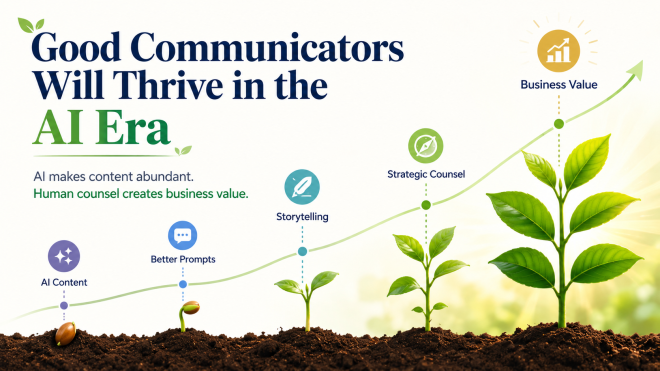
Communicators, listen up: It’s time to stop freaking out about whether AI will replace us. The better question is this: What work becomes more valuable when everyone has access to AI?
That theme surfaced repeatedly across two recent episodes of Cracking the Comms Code. Communications leaders from healthcare, technology, agencies, internal communications, and media relations — including Jasper Hamill, Lindsay Lapchuk, Alan Shoebridge, Keith Berman, Jennifer George, and Meredith Klein — explored what AI is really doing to comms, not what everyone fears it’s going to do.
Put simply, AI is dividing the people who create content from the people who create business value. The winners will be the communicators who do both — but are known primarily for the second.
Content vs. Counsel
The first panel focused on the content side of the AI era. Shoebridge argued that there’s now a strong inverse relationship between content (abundant) and strategic counsel (scarce). The “A” in “AI” doesn’t stand for “adviser” – the robot won’t tell you (or at least won’t do a good job telling you) what should be communicated, when, to whom, and why it matters to the business.
That’s where Shoebridge said the best communicators will stand out. They’ll move beyond trying to outrace AI systems and move to where humans do their best work – talking to other humans, understanding problems, and creating solutions.
Part of counsel is knowing the content strategy, including what narratives hit home the best. It’s easy to use AI tools for content creation, so the next frontier is learning (quickly) to use them well.
Hamill argued that the premium now sits on exceptional stories, memorable headlines, and interviews that uncover insights experts didn’t realize they had.
How do you get the AI to do all that? It starts with asking better questions.
Instead of broad prompts, experienced communicators ask for specific moments, decisions, or turning points. That gets them the gem in a piece of content to develop into a story that hits home.
And, finally, yes, you do have to know what AI search is up to. Lapchuk explained that customers, investors, job candidates, and journalists increasingly begin their research with AI tools. Every organization already has an AI reputation, whether it is managing one or not.
The strongest communications teams are working alongside SEO, sales, and product marketing to understand the questions buyers actually ask and to ensure AI systems have accurate information about their companies. Earned media, executive thought leadership, customer stories, and owned content all contribute to the information AI uses to generate answers.
Companies can’t control every AI response. They’ll have to work twice as hard, then, to influence the information that drives those responses – starting with counsel, then finding outstanding narratives, and then making sure those narratives spread properly.
The Right Counsel Earns Trust – and Budget
The next panel barely mentioned AI, but elevated the “counsel” conversation to its highest strategic levels.
George urged communicators to tie their work to acquisitions, restructurings, market expansion, and other major business decisions instead of communications outputs. She said asking the finance squad for help did wonders for her business education and, later, her career as a comms executive.
Klein encouraged professionals to think like business leaders who specialize in communications rather than communicators trying to learn business. That’s the only way to ensure that the C-Suite listens to you, on everything from forward-looking predictions to urging them to ditch the tie and go with an authentic approach to executive messaging.
But trust doesn’t always come with all of the necessary tools. The Wall Street Journal article about CCOs storming the C-Suite had a number of shortcomings, including what George called an “unfunded mandate” where a single high-paid person is doing the work of five. Sure, the title and cash are nice…if you don’t burn out.
So start quantifying your work. Measure your workloads, calculate the cost of poor communication (you can be creative about this), and demonstrate how effective internal communications improve productivity and reduce risk. When you have data to leverage, you can act like the finance department and make a business case for your work, and the resources it deserves.
And, finally, Berman argued that if you want to be trustworthy, speak candidly. He’s been in external and internal comms, and since employees are a company’s most powerful asset, speaking candidly (and intelligently, armed with the data) is the only way to ensure that you are seen as equal to the longstanding members of the C-Suite.
Enjoy each panel discussion in full below.
