
Driving better outcomes: The skills needed for PR success
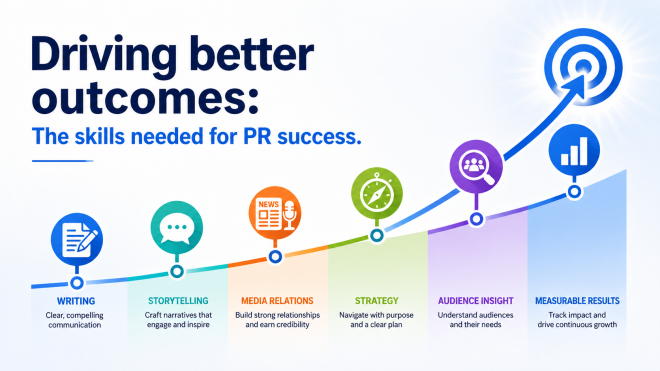
PR professionals are great communicators, storytellers, and strategists. But clients don’t want to read an impressive résumé; they need to see results. That means all our expertise is meaningless unless it’s applied to achieving real outcomes.
In a trilogy of Cracking the Comms Code episodes, we convened industry experts and thought leaders to explore how PR professionals can level up their skillsets to drive the greatest possible impact. Here’s what they told us.
Elevating your PR skillset
Our panelists agreed that although sector knowledge can be a genuine advantage in specialized fields, core skills matter more than narrow experience. PR professionals with strong fundamentals — writing, storytelling, media relations, audience awareness — will always be in demand across industries. What matters is whether you’ve handled similar challenges, not whether you’ve worked for an identical company.
Bringing the right mindset is just as important. That means showing up curious, coachable, and prepared to ask the right questions so you can learn quickly. Understanding how your client’s business works is critical. PR professionals need to know what leadership cares about, how the company makes money, the challenges it faces, and how communications can move the needle.
When speaking with decision-makers, avoid slipping into jargon. Translate your value into business language. Tactics like placements and outputs are only part of the story — what matters is how they connect to a broader strategic goal. The role of a strong PR advisor is to guide leadership and speak credibly to the C-suite. Dig deeper into this conversation with Amanda Coyle of Resilere Partners, Ted Merz of Principals Media, and Executive Communication Strategist Trish Nicolas.
Getting it right from the start
Too many PR campaigns fail before they’ve even begun. Teams build in isolation, protect the “big reveal,” and then wonder why nothing lands. The smarter approach is simple: Test early. Float ideas with a small group of trusted reporters, gather real feedback, and refine before committing.
Relationships matter here. They won’t save a weak story, but they do provide signal — faster replies, honest reactions, and a clearer sense of what will resonate.
Execution then becomes about removing friction. Make the reporter’s job easy. Offer your spokesperson, but also offer multiple angles. Package assets in a way that works for the particular reporter you’re courting. Coverage is far more likely when you’ve laid the groundwork.
It’s also important to think beyond attribution. Getting your client named could be “a good start” instead of the victory. Shaping the broader narrative — and being included as a credible voice within it — often matters more.
None of this works without a clear understanding of the client’s business. PR decisions should reflect commercial reality, internal politics, and leadership priorities. Talk to senior stakeholders early, and make sure your ducks are in a row before you make a push. Many “PR problems” are, in reality, internal clarity problems.
When engaging media, keep it sharp. Pitches should be brutally concise. You don’t need to be comprehensive to garner interest, and you don’t need company boilerplate. If the first line doesn’t land, nothing else matters.
Finally, operate in the world as it is today. There are fewer journalists, with more noise and tighter competition. AI is accelerating output, but the quality isn’t keeping up. That makes targeting, relationships, and judgment more valuable. Chris Piedmont of Slide Nine, Adam Brooks of Candor, and Chase of METATHEORY break-down some of their tips and tricks for PR practitioners here.
From activity to outcomes
The shift PR agencies need to make is straightforward: stop obsessing over doing things, and instead obsess over accomplishing things.
That sounds simple, but it’s harder in practice. It means validating ideas early, aligning internally, executing cleanly, and focusing on influence over volume. Clients won’t be impressed if you tell them nothing but how busy you are. They care about what changed.
The starting point is clarity. Define success upfront in plain terms — revenue, reputation, influence — and work backward. Explain your impact in business language, or else you won’t make the case.
From there, strip out the noise. Drop jargon and long reports. A clear one-pager linking actions to outcomes will outperform any bloated deck. And remember whom you’re really serving: not just your day-to-day contact, but the C-suite above them. If your contact can’t easily explain your value internally, the chopping block is just down the road.
Execution works only when it connects to the wider business. PR amplifies marketing, sales, and positioning. Or at least it should. When it doesn’t, results will always fall short. In this panel discussion Lynda Carlisle of CS-Effect, Melissa Havel of Turnitin, and Ashley Dennison of CommsConsultants.com share their expertise on driving real client outcomes.
Truth-telling and meaningful metrics
It’s also critical to be honest about what PR can and can’t do. You can’t guarantee coverage — and pretending you can erodes trust. What you can guarantee is consistency, direction, and a steady build of presence over time. That shift from chasing hits to building momentum is where many teams founder.
The same applies to targeting. Reach is easy to inflate and largely meaningless. Relevance is more elusive, and far more valuable. A small, engaged audience that reacts is worth more than a large one that barely knows you. Step away from the vanity metrics and measure what actually matters: message pull-through, meaningful engagement, and inbound signals.
At a higher level, the role itself needs to evolve. Strong practitioners act as partners. They push back, refine ideas, and stay close to the market. They provide activity, certainly, but the real value lies in their judgment.
That becomes even more important as AI accelerates output. Everyone is tied now in the race to see who can produce the most, but there’s still competition for who can think the best. Used properly, AI helps you move faster, not think less. Average content is now abundant. Insight is not.
In the end, everything comes down to one question: Did this PR campaign change anything that matters? Unless the answer is yes, clients have every right to be unhappy.
Watch each panel below.
