
Rebuilding PR practice for the AI answer economy
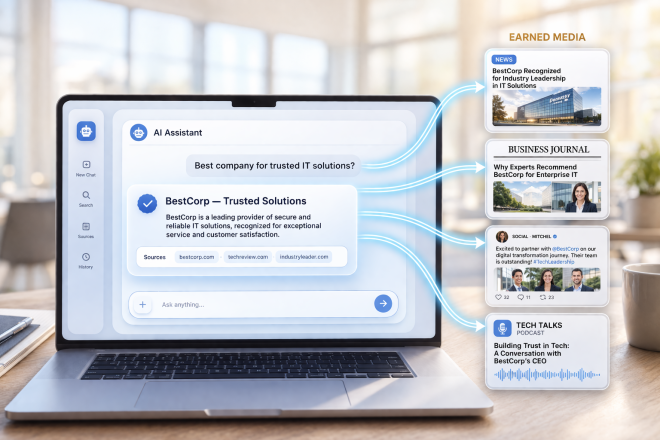
Communications professionals have spent the past decade optimizing for visibility, focused on front-page coverage, trending hashtags, influencer spikes, and share-of-voice charts. Now the industry is turning its attention to a new channel with the potential to match — and potentially surpass — the influence of even the most powerful traditional media: AI.
Proven Media Solutions explored how AI is altering the media landscape and driving the emergence of a new answer economy across two episodes of Cracking the Comms Code, featuring:
- Five Blocks CEO Sam Michelson, Scale Without Chaos founder Samantha Riel, and Zen Media founder and PR strategist Sarah Evans on AI’s impact on the PR industry.
- Meredith & The Media founder Meredith Klein, Friday Reporter Public Affairs founder and host Lisa Camooso Miller, and Sources of Sources founder Peter Shankman on what’s next in corporate comms.
Here are the most important takeaways.
Visibility is being rewired
Perhaps the most counterintuitive insight was also the most commercially important. Despite widespread industry assumptions, the sources shaping AI-generated answers are often not traditional earned media.
Practitioners tracking thousands of prompts across major large language models are finding that owned content, such as corporate websites, structured brand information, and even open press releases, shapes responses the most. Earned media still matters, but it is operating more as a reputational validator than the primary informational input.
This distinction changes how communication value should be sold and measured.
If audiences are asking AI tools to synthesize recommendations or explain markets, they may never click through to coverage at all. It might not be enough anymore for an organization to be mentioned in a piece of earned media. Instead, the organization needs to be “front of page” as the answer to the question searchers are asking.
In practical terms, strategy must evolve from media placement to something closer to answer engineering, which means mapping the questions stakeholders ask and ensuring authoritative brand content exists to address them.
Productivity gains are buying back time
AI is making certain work faster and more efficient. What’s good about that is the time communicators now have on their hands to take care of higher-level tasks. But it also means higher expectations.
On the one hand, teams are already using AI to turn live conversations into content pipelines, transform messy strategic thinking into structured plans, and accelerate operational decision-making. On the other hand, an employee who once generated $120K of annual value may soon be expected to deliver multiples of that.
On both hands, the takeaway is that AI amplifies the need for human judgment. Used well, it gives thinkers and doers the bandwidth to think and do, with good results up and down the company. Used badly, it takes over uniquely human functions and industrializes mediocrity at every level.
The most effective practitioners treat AI like a junior colleague – training it, correcting it, and refining outputs. Organizations expecting one-line prompts to replace expertise may find that AI-hallucinated strategies are simply fancier ways to put themselves at the back of the line.
Corporate crises now burn hotter and faster
Attention cycles in corporate communications are collapsing, meaning crises can erupt and disappear within minutes — or go on a long rampage, and someone has to know which kind we’re dealing with from moment to moment.
In a media environment where a geopolitical conflict, a viral customer complaint, and a celebrity meme can appear in the same social feed, audiences process outrage differently. Often, they move on fast — even before corporate responses clear legal review. This creates a paradoxical new discipline: knowing when not to respond.
Strong organizational values remain the most reliable compass. Companies grounded in consistent messaging and clear principles are better able to weather episodic storms. Preparation is therefore less about predicting specific events and more about stress-testing core positions in advance.
Clarity is still king — both in how crises are handled and in how organizations present themselves both to outside consumers and inside team members.
Trust is fragmenting – again
Perhaps the most provocative shift involved in the AI answer economy is social rather than technological.
Audiences are increasingly bypassing institutional voices in favor of smaller, more familiar ones: local journalists, niche creators, subject-matter experts, and micro-influencers embedded in real communities.
Research and practitioner experience both suggest that local media retain disproportionately high trust. A recommendation from a neighbor or respected specialist may drive more behavior than a national campaign reaching millions. Meanwhile, mega-influencer credibility has eroded as it’s become harder to hide that the big guys are just trying to sell something.
For communications buyers, this creates a difficult recalibration. It’s cheap to reach the masses but more expensive than ever to persuade them.
The craft is still everything
One important point to remember is that the same skills that drove success in the 20th century remain relevant today. Narrative still matters. So do third-party validation and consistent positioning. What has changed is the mechanism through which these strengths are discovered and acted upon.
AI-mediated discovery will reward organizations that carefully and thoroughly stock their content libraries. Corporate volatility will reward those with pre-agreed value frameworks and faster internal decision pathways. Fragmented trust will reward communicators who cultivate authentic advocates rather than chasing vanity metrics.
Above all, the impact of communications must increasingly be demonstrated in business terms. Board-ready metrics like visibility in AI outputs, influence on purchasing pathways, and contribution to revenue will shape future budgets — so professionals need to be prepared to chase these numbers and prove their achievements.
A new brief for buyers – and the industry
For organizations investing in communications services, the takeaway is not that PR has become obsolete, but that the definition of effective PR has expanded dramatically. We need more than just coverage, more than just speed, more than just scale.
Buyers should now demand strategies designed for how information actually moves: integrated owned-and-earned ecosystems, measurable visibility in AI discovery, influence rooted in credible voices, and productivity models aligned to real business outcomes.
For communications professionals, the message is sharper still. AI is exposing where the discipline was never applied rigorously enough. The opportunity ahead is enormous, but only for those willing to stop optimizing for impressions and start competing to become the answer.
Dive deeper into the full conversations in the videos below.
