
From Legislative Season to the Midterms: Coalitions & Impactful Media Coverage
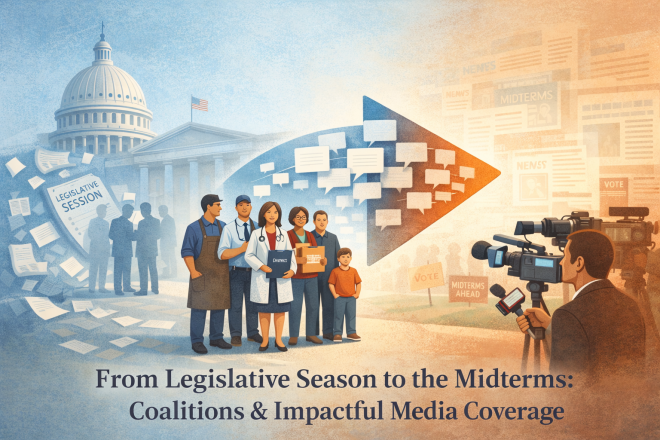
When one person says, “This law is hurting people,” he sounds like a lone voice with a personal gripe. But when a dozen people say the same thing, the issue suddenly becomes a community concern.
That simple example shows the power of coalitions, which can turn a niche problem that looks like self-interest into a shared issue that voters, journalists, and lawmakers need to take seriously.
That was the focus of an episode of Cracking the Comms Code hosted by Dustin Siggins, founder of Proven Media Solutions. He was joined by three colleagues: Kerri Toloczko (Director of Public Affairs), Robert Kuykendall (Director of Accounts), and Jordan Banegas (Director of Special Projects).
The power of legislative coalitions
The timing mattered. Legislative season was beginning in many states, and the midterms were only months away. That combination changes incentives fast. Lawmakers become more sensitive to what is happening back home. They pay closer attention to local news, get more cautious about votes that can be framed as out of touch, and become more responsive to organized pressure because, as elections approach, political risk shapes decision-making. In that environment, coalitions become one of the most practical tools available. They demonstrate breadth, credibility, and local relevance simultaneously.
One story captured the mechanics of coalition-building perfectly. A lobbying push sent a dozen letters to a member of Congress through the legislator’s local office. The sender knew exactly how many were submitted, because the sender personally faxed them through.
Later, when the group met with the legislator, he claimed to have received eighty letters on the issue. The point was not the technology or even the exact numbers. It was the takeaway: coalitions multiply and amplify voices, expanding what lawmakers perceive as the size of an issue. A dozen letters from one organization look like lobbying. A flood of messages from a range of people seems more like pressure from the district, and politicians always take the district more seriously than a single organization.
The right people with the right messages
Another example challenged a common assumption. People often think coalitions matter only when they are massive. In practice, some state-level fights are won with only a handful of advocates if they are strategically positioned and credible.
One case in Georgia showed this clearly. A bill made it across the finish line with very few activists involved. Those individuals weren’t famous or super-rich. They mattered because they represented a broader group and could speak as practicing professionals or community members. Lawmakers are counting support…and also calculating risk. A small number of trusted local voices can create more political risk than a large but distant group that appears to have an agenda.
Coalitions also shape media coverage in a way many organizations underestimate. Media narratives are shaped by whoever shows up. If one side organizes a rally at the state capitol and reporters attend, the story will naturally tilt toward the people who are physically present and ready to speak. The coalition’s job is to ensure credible voices are there to provide a second side of the story.
This is also why preparation matters. Coalition members need simple materials, clear talking points, and basic discipline. In practice, this is how coalitions generate “impactful media coverage”: not through clever press releases, but through coordinated timing, credible messengers, and being present where the story is already forming.
A final story brought the conversation back to the real-world overlap between business interests and local politics. A state legislator explained that he did not hold strong ideological positions on every policy detail, but he cared deeply about how legislation would affect small, independent providers in his district.
In rural areas, those providers are people everyone knows: pharmacies, clinics, medical equipment suppliers, and other small businesses that sustain the community. When those providers are aligned, they become a coalition almost by default. And because they are trusted locally, lawmakers listen to them.
Diverse people, one narrative
Helping to pass or kill a bill is one thing. But coalitions also build a relationship. The legislator advocates for these community figures at the Capitol, and those same figures become validators for the legislator back home. With the midterms approaching, that validation becomes even more valuable.
Coalition-building carries risks, make no mistake. The more voices you add, the more unpredictable the coalition becomes. One person can say something reckless and derail the whole effort. Coalitions need basic discipline: a clear purpose, someone willing to coordinate, simple messaging guidance.
You don’t have to script people like robots to achieve this. You can just ensure that coalition members understand what matters most to say – and just as importantly, what not to say. Coalitions create power by multiplying voices, but that same multiplication increases the chance of mistakes unless someone is actively managing the effort.
The closing point was blunt: timing is everything. Coalition-building is least effective if you start in the middle of a legislative session, when staffers are overwhelmed and every interest group in the state is calling at once.
If you want to be heard, you have to build relationships early, provide resources early, and coordinate messages before the noise peaks. Lawmakers are humans, and the most influential conversations often happen outside formal channels, through trusted community members in everyday settings.
Coalitions make – or break – perception
Coalitions are powerful for the same reason they have always been powerful: they change perception. They take an issue from “one organization pushing its agenda” and turn it into “a community of people who care.” That matters in any year, but it matters most during legislative season and in the run-up to the midterms, when lawmakers and media are looking for signals about what the public will reward, what it will punish, and what it will remember.
Catch our full breakdown in the video posted below.
